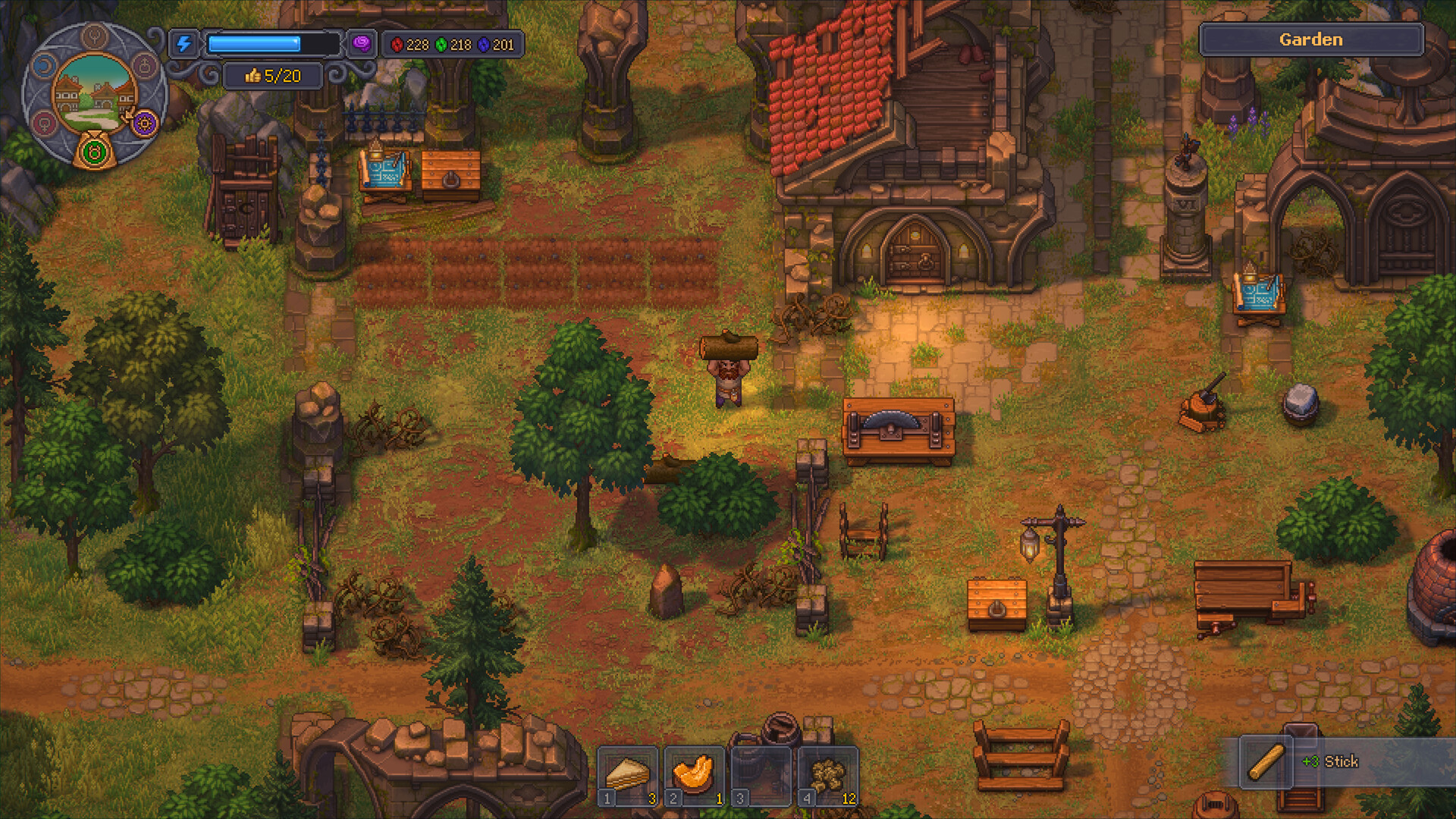
Graveyard Keeper 2 organizes crafting around six workstation families, a couple of adjacent systems, and a six-branch research tree. Recipes unlock through the technology tree, but a known recipe can still be blocked by missing ingredients, energy, talents, or workstation extensions — tech unlocks are necessary but not sufficient.
More context
Earning research points: Points are earned by studying items at the Study Table (the technology tutorial places it in the Church basement, where the first Blue points are earned). Each studied item awards a fixed red/green/blue reward plus Science and sometimes Faith. The tree spans six branches — Building, Metallurgy, Farming, Theology, Anatomy and Alchemy, and Cooking — with roughly 226–236 named technologies total across them. Each node has its own red/green/blue point cost, may require a direct prerequisite technology purchased first, and may additionally be reputation-gated (for example, Jack in Building or Herbert in Metallurgy).
On this page
The six workstation families
Woodworking
Sawhorse, Woodworking Workbench I/II.
Metalworking
Smithy I/II, Furnace I/II, Casting Table.
Stone and Pottery
Stone Cutter, Pottery Wheel.
Factory
Assembly Bench I/II/III, Smithy, Bioreactor, Lifting Crane, Conveyor stations.
Writing
Writing Desk, Study Table, Scriptorium.
Jewelry Table
A sequel-specific workstation that builds Zombie Collars for taming zombie workers.
Adjacent systems
Cooking Recipes
Food and bait batches at kitchen stations. Cooking unlocks cheap tech nodes that cost no spheres.
Alchemy Recipes
Rune-matched potion combinations at the Laboratory.
Battle Potions
Combat-flavored subset of alchemy.
Workstation planning
Plan and build workstations via the Blueprint Desk and Workshop Construction system. Other infrastructure in the chain: Firewood Shed supplies fuel. Zombie Gardening plots feed a Gardener Stand worker. Sawhorse, Study Table, Formulation Bench, Bioreactor, Crematorium, Distillation Cube, Furnace, Hypno Device — specialized stations for their respective loops.
Common materials
Materials referenced across recipes include Short Log, Wooden Plank, Board, Firewood, Bronze Nails, Bronze Detail, Bronze Ingot, Polished Bronze, Iron Ingot, Iron Detail, Iron Ore, Brick, Clay, Clay Plate, Glass, Gold, Clean Paper, Ink, Basic Rod, Green Scroll, plus alchemy inputs such as Alcohol, Honey, Beeswax, Blue Crystal, Dream Dust, Firefly, and Fragrance.
Tool tiers that gate recipes
Wooden Kit I
Earliest recipes.
Stone Kit
Stone and masonry recipes.
Iron Kit I
Metalworking recipes.
Building Kit I
Construction recipes.
How the technology tree works
Graveyard Keeper 2's technology tree is funded by three research-point currencies, each capped at 999. Red — handcrafting and working with materials. Green — nature. Blue — spiritual knowledge. Points are earned by studying items at the Study Table (the technology tutorial places it in the Church basement, where the first Blue points are earned). Each studied item awards a fixed red/green/blue reward plus Science and sometimes Faith.
Branch rules
Cooking is the cheapest branch because its 20 nodes cost no spheres at all. Building runs about 85% on Red. Building, Metallurgy, and Farming open as soon as the player wakes up at home. Anatomy opens when the first body reaches autopsy. Theology opens through interactions in the Nun's storyline.